
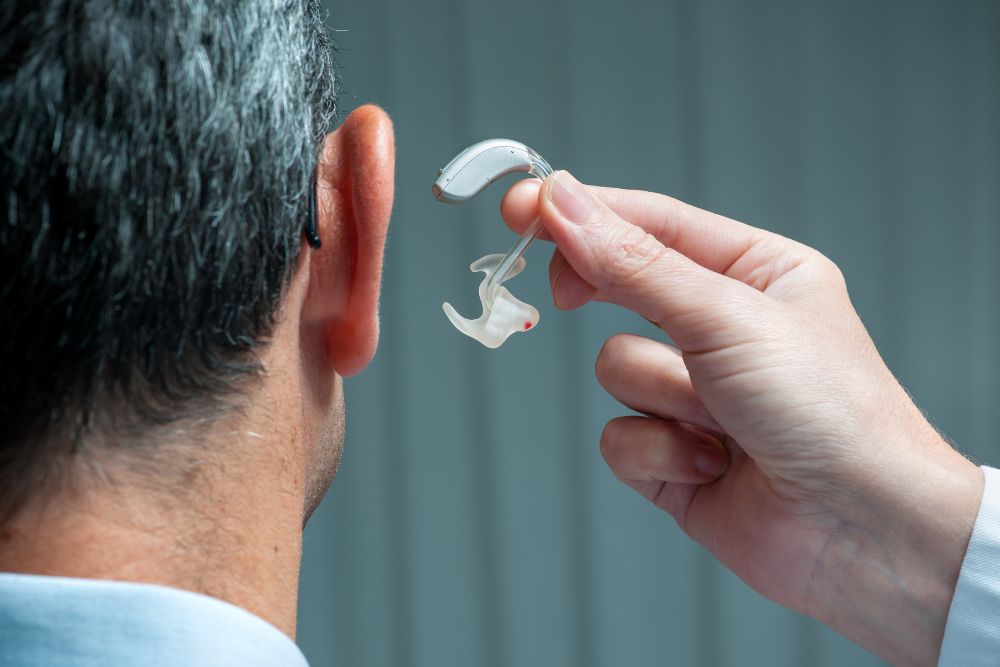
Earlens® is a prescription hearing technology designed for adults with mild to severe sensorineural hearing loss who can benefit from amplification. Unlike conventional hearing aids that use a speaker to deliver amplified sound through the ear canal, Earlens uses a custom-fitted Lens positioned directly on the eardrum and a processor that transmits sound to the Lens using light. The Lens then gently vibrates the eardrum, providing amplification across a broad frequency range. Earlens is a specialized hearing solution that requires medical and audiologic evaluation to determine whether the ear anatomy, hearing loss, and individual hearing needs are appropriate for the technology.
Walter’s Experience with the Earlens Hearing Aid
What Is an Earlens Light-Driven Hearing Aid?
Earlens is a type of contact hearing aid that uses a different method of delivering amplified sound than a traditional acoustic hearing aid. Instead of placing a miniature speaker in or near the ear canal, Earlens uses a custom Tympanic Lens that rests directly on the eardrum. A behind-the-ear Processor captures sound and sends the audio signal and power through a custom Ear Tip to the Lens. The Lens then mechanically vibrates the eardrum to transmit amplified sound through the natural hearing system. The Earlens system is designed for adults age 18 and older with mild to severe sensorineural hearing impairment who can benefit from amplification. It is a prescription hearing device, not an over-the-counter hearing aid.
How Does Earlens Work?
Earlens combines three primary components: a Processor, a custom Ear Tip, and a custom Tympanic Lens. The Processor captures sound and converts it into an audio signal. The Ear Tip transmits that signal to the Lens, which is positioned directly on the eardrum. The Lens uses the received signal to gently vibrate the eardrum, rather than producing amplified sound through a conventional speaker.
Because the Lens directly stimulates the eardrum, Earlens is designed to provide amplification over a broad frequency range. FDA documentation for the Earlens Light Driven Hearing Aid specifies amplification from approximately 125 Hz to 10,000 Hz. The ability to access a broad range of frequencies is one reason Earlens may be considered for patients who want a different approach to sound quality, speech clarity, or high-frequency amplification.
How Is Earlens Different From a Traditional Hearing Aid?
Traditional hearing aids use an acoustic receiver or speaker to amplify sound in the ear canal. Earlens takes a different approach by placing a custom Lens directly on the eardrum and using light-driven technology to transmit the signal. This allows the device to deliver mechanical vibration directly to the eardrum rather than relying on a conventional acoustic speaker.
This difference may be particularly relevant for people who are dissatisfied with the sound quality, frequency range, feedback, or listening experience they have experienced with conventional hearing aids. However, Earlens is not automatically better for every person with hearing loss. Candidacy depends on the type and degree of hearing loss, ear health, anatomy, lifestyle, and the individual’s hearing goals.
Who Is a Candidate for Earlens?
Earlens is intended for adults age 18 and older with mild to severe sensorineural hearing loss who can benefit from amplification. A complete evaluation is necessary because Earlens requires specific ear anatomy and healthy conditions of the ear canal, eardrum, and middle ear.
Potential candidates may include adults who:
- Have mild to severe sensorineural hearing loss
- Want amplification across a broad frequency range
- Are looking for an alternative to conventional acoustic hearing aids
- Want to explore a hearing solution designed around their individual ear anatomy
- Have specific hearing goals involving speech clarity, music, streaming, or listening in complex environments
- Have appropriate eardrum, middle-ear, and ear-canal anatomy for placement of the Lens
Not everyone is anatomically or medically suited for Earlens. An abnormal eardrum or middle ear, certain ear-canal anatomy, recurrent ear infections, rapidly progressive or fluctuating hearing loss, and other medical factors can affect candidacy.
Who May Not Be a Candidate for Earlens?
Earlens requires direct placement of a custom Lens on the eardrum, so the health and anatomy of the ear are important parts of the evaluation. Patients with an abnormal or perforated eardrum, certain middle-ear conditions, inadequate ear-canal anatomy, or other contraindications may not be appropriate candidates. A history of recurrent ear infections and rapidly progressive or fluctuating hearing impairment can also affect eligibility.
A hearing evaluation alone does not determine Earlens candidacy. The assessment may include audiologic testing as well as examination of the ear canal and eardrum by an ENT physician. The goal is to determine whether Earlens is medically appropriate and whether its technology matches the patient’s hearing needs.
What Is the Earlens Fitting Process?
Earlens requires a coordinated approach between an audiologist and an Ear, Nose, and Throat physician. The physician evaluates the ear and takes a specialized impression of the ear canal and eardrum. That information is used to create the custom Lens and Ear Tip for the patient’s anatomy. After the custom components are prepared, the ENT physician places the Lens in position on the eardrum. The audiologist then fits, calibrates, and programs the Processor according to the patient’s audiogram and hearing needs. Follow-up visits allow the hearing team to make adjustments and optimize the fitting over time.
Is Earlens a Hearing Implant or Surgery?
No. Earlens is not a surgically implanted hearing device. The Tympanic Lens is placed in the ear canal and positioned on the eardrum during an in-office procedure. According to Earlens, Lens placement and removal do not require anesthesia, and the Lens can be removed by an appropriately trained ENT physician. This makes Earlens fundamentally different from surgically implanted hearing technologies such as cochlear implants. However, because the Lens sits directly on the eardrum, medical examination and specialized fitting are required.
What Are the Benefits of Earlens?
The potential benefits of Earlens relate primarily to its method of sound delivery and broad frequency response. The system is designed to provide amplification across a wider frequency range than conventional acoustic hearing aids, including higher frequencies that can contribute to speech perception and sound quality.
Some patients may consider Earlens because they:
- Want access to a broad range of amplified frequencies
- Prefer a different approach to sound delivery
- Have difficulty achieving their desired hearing experience with conventional hearing aids
- Want to explore a custom-fitted hearing solution
- Place a high value on speech clarity, music, or streaming audio
Clinical outcomes and individual experiences vary, so the potential benefits should be discussed in the context of each patient’s hearing test, anatomy, previous hearing-aid experience, and communication goals.
Earlens for Speech, Music, Streaming and Noisy Environments
Hearing technology needs to perform in more than a quiet examination room. Patients may want to hear conversations at restaurants, participate in meetings, enjoy music, use a phone, or stream audio throughout the day. Earlens is designed to provide a broad range of amplification and includes signal-processing features intended to support different listening environments. Earlens also offers customized programs for different listening situations. Patients should discuss the environments in which they have the greatest difficulty hearing because these real-world listening needs can help guide the fitting and programming process.
What Should You Expect When Wearing Earlens?
Like other hearing technologies, Earlens may require an adjustment period. Because the Lens is positioned directly on the eardrum, some users initially notice a sensation in the ear, although Earlens reports that this feeling generally becomes less noticeable with time. The Lens is designed to remain in place while the external Processor is removed for charging.
Earlens also requires ongoing care and follow-up. Patients receive instructions for maintaining the Lens and ear canal, including the use of mineral oil as directed by their physician. Regular evaluation helps the clinical team assess the position and condition of the Lens and make programming or fitting adjustments when needed.
Earlens Evaluation and Hearing Care in NYC
Choosing Earlens begins with determining whether it is medically and audiologically appropriate for you. At The New York Hearing Center, an evaluation can assess your hearing loss, previous experience with hearing aids, communication needs, and goals for hearing technology. When appropriate, medical evaluation of the ear can also help determine whether your eardrum, middle ear, and ear-canal anatomy are compatible with a tympanic Lens.
Earlens is a specialized option, and the right hearing solution depends on the individual. For some patients, a conventional hearing aid may provide the most appropriate combination of performance, convenience, and connectivity. Others may benefit from exploring Earlens or another advanced hearing technology. A personalized hearing-aid evaluation can help determine which option best fits your hearing loss and lifestyle.
Why Choose The New York Hearing Center for Earlens?
Advanced hearing technology is only as effective as the evaluation, fitting, programming, and follow-up behind it. The New York Hearing Center provides comprehensive hearing care focused on matching patients with technology appropriate for their hearing loss, anatomy, communication needs, and daily listening environments. If you are interested in Earlens hearing aids in NYC, an evaluation can help determine whether this light-driven hearing technology is appropriate for you and whether another hearing solution may better address your needs. Schedule a hearing evaluation to learn whether Earlens may be an appropriate option for your hearing loss.
Frequently Asked Questions
Earlens is a prescription hearing technology designed for adults with mild to severe sensorineural hearing loss. It uses a custom-fitted Lens placed directly on the eardrum and a processor that transmits sound via light to the Lens. The Lens vibrates the eardrum mechanically, providing amplification across a broad frequency range from approximately 125 Hz to 10,000 Hz, which differs from traditional hearing aids that use speakers to deliver sound acoustically.
Earlens is intended for adults aged 18 and older with mild to severe sensorineural hearing loss who can benefit from amplification. Candidates must have appropriate ear anatomy, including a healthy eardrum, middle ear, and ear canal, and should have specific hearing goals such as improved speech clarity or music appreciation. A thorough medical and audiologic evaluation is required to determine candidacy.
Unlike traditional hearing aids that use an acoustic speaker to amplify sound in the ear canal, Earlens uses a custom Lens placed directly on the eardrum and transmits sound via light to mechanically vibrate the eardrum. This method allows for amplification over a broader frequency range and may improve sound quality, speech clarity, and reduce feedback issues experienced with conventional devices.
No, Earlens is not a surgically implanted device. The custom Lens is placed on the eardrum during an in-office procedure by an ENT physician without the need for anesthesia. The Lens can also be removed by a trained physician, making it a non-surgical hearing solution distinct from cochlear implants or other implanted devices.
The fitting process for Earlens involves collaboration between an audiologist and an ENT physician. The physician evaluates the ear and takes a specialized impression of the ear canal and eardrum to create custom components. The Lens is then placed on the eardrum, and the audiologist fits, calibrates, and programs the Processor based on the patient's hearing profile. Follow-up visits help optimize the device's performance.
Individuals with abnormal or perforated eardrums, certain middle-ear conditions, inadequate ear-canal anatomy, recurrent ear infections, or rapidly progressive or fluctuating hearing loss may not be suitable candidates for Earlens. A comprehensive medical and audiologic evaluation is necessary to determine if the device is appropriate.
Earlens offers amplification across a broad frequency range, including high frequencies important for speech perception and sound quality. It provides a unique sound delivery method that may improve speech clarity, music enjoyment, and streaming audio experiences. The device is custom-fitted to individual ear anatomy and designed to perform well in various listening environments.